


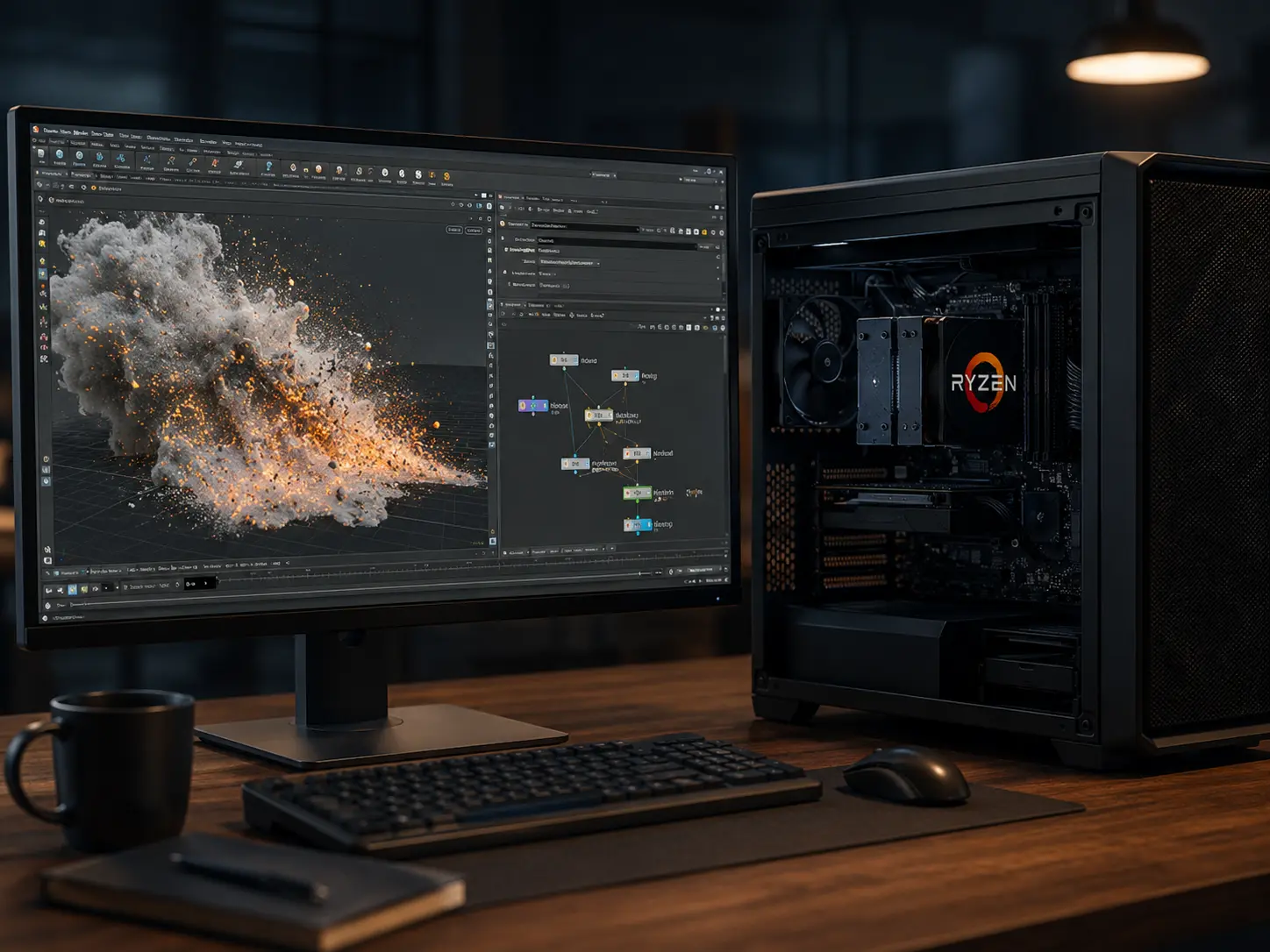
The flow of creative ideas is hampered by the need to spend a lot of time on each change because of slow rendering or tedious tasks that have to be done manually. Today’s 3D workflow demands not only quality but also faster iterations to comply with tight deadlines and more complicated scenes to work on. In this case, efficient processes, procedures, AI-related components, and appropriate hardware allow for rapid adjustments without sacrificing quality.
A Smarter Approach to Faster 3D Iterations
Increasing the pace of iteration does not involve taking shortcuts. It means eliminating all the unnecessary delays to ensure that artists spend less time on repetitive tasks and more time working on their concepts. The following are ways through which you can make sure that your project remains productive throughout its duration.
1. Why Faster Iterations Matter in Complex 3D Workflows
Today, many productions feature millions of polygons, materials, simulations, and elaborate lighting. Any changes made will impact several aspects of a project, and thus, a slow workflow is inefficient and costly. Choosing hardware built for demanding creative applications, such as SideFX Houdini and a Ryzen workstation, allows artists to work more smoothly with heavy scenes while reducing delays during look development and simulation.
Faster iterations also improve communication between artists, supervisors, and clients. When updates can be reviewed immediately, feedback cycles become shorter, allowing creative decisions to happen before production schedules are affected. This keeps projects moving while reducing unnecessary revisions later in the pipeline.
2. Real-Time Rendering Improves Creative Decisions
Constantly waiting for final-quality renderings every time an adjustment is made halts the thought process of creativity. The real-time rendering technology allows artists to see the effects of lights, textures, reflections, and camera movements within a very short period of time, making experimentation possible.
Using proxy geometry, simplified shaders, and low sample rates while doing look development makes the viewports responsive even when working on complicated scenes. Thanks to the denoising technology, it has become easy for artists to assess materials and compositions even before rendering the final images.
The real-time feedback system enables experimentation. With the real-time feedback system, one does not have to restrict his/her creativity options because of slow rendering.
3. Procedural Workflows Eliminate Repetitive Tasks
Procedural workflows make complex projects easier to manage because changes remain editable throughout production. Instead of rebuilding assets from scratch, artists simply adjust parameters, allowing entire systems to update automatically.
Node-based workflows simplify environment creation, simulations, material generation, and animation. This flexibility becomes especially valuable when directors request changes during production, as artists can update scenes without having to recreate previous work.
Maintaining organized node networks also improves collaboration across teams. Other artists can understand the setup more quickly, reducing production delays and minimizing the risk of introducing errors during revisions.
4. AI Helps Artists Generate Faster Results
Artificial intelligence has now become an efficient production assistant and not a replacement for creativity. This technology helps in doing the tedious work for artists so that they are free to focus on their stories and their creativity.
AI can help in completing such tasks like texturing, material variation, masking, cleaning of objects, and concept development within minutes rather than taking hours. These are just some of the ways that artists will be able to use AI technology to explore different paths creatively before settling on one.
A SideFX Houdini Standard Edition computer setup will have sufficient processing capability for simulating and procedurally generating assets as well as using AI in production.
5. Build Reusable Assets for Long-Term Efficiency
Every completed project creates opportunities to improve future workflows. Creating such an asset library enables artists not to have to create material that has been previously created. Materials, lighting setups, procedural node networks, rigs, particle systems, and environment materials greatly save time. Rather than having to start off from scratch with each piece of material, artists will be able to modify previously created materials.
Well-organized asset libraries also support team collaboration. Shared resources help maintain visual consistency while reducing duplicate work across departments, making larger productions easier to manage.
6. Optimize Hardware to Support Continuous Creativity
Even though the most optimized workflows require hardware to be responsive as well. Large environments, high-quality texture resolution, simulations, and real-time rendering require great amounts of computing power from CPU, GPU, disk drives, and RAM.
CPU with great computational power will help in simulations and calculations, whereas a GPU will ensure responsive viewports and fast real-time rendering. Fast NVMe drives will speed up loading time, and enough RAM will give an artist the possibility to work with large environments without constantly switching between the disk drive and RAM.
A properly balanced hardware configuration will ensure that no interruption occurs during the whole process of production, and the artist will be able to make all creative decisions.
Staying Competitive as 3D Projects Continue to Grow
Studios increasingly rely on efficient workflows to deliver larger projects within shorter production schedules. Despite the existence of powerful workstation options by companies like Puget Systems and BOXX Technologies, some situations call for computers that are tuned not only to general high-performance computing but rather specifically for certain kinds of creative applications.
In particular, Cloud Ninjas provides professionally tuned computers intended specifically for use by artists in 3D software. This focus allows creative workers to iterate faster, have fewer interruptions in their workflow, and finish complicated projects smoothly and efficiently.
Also Read

