


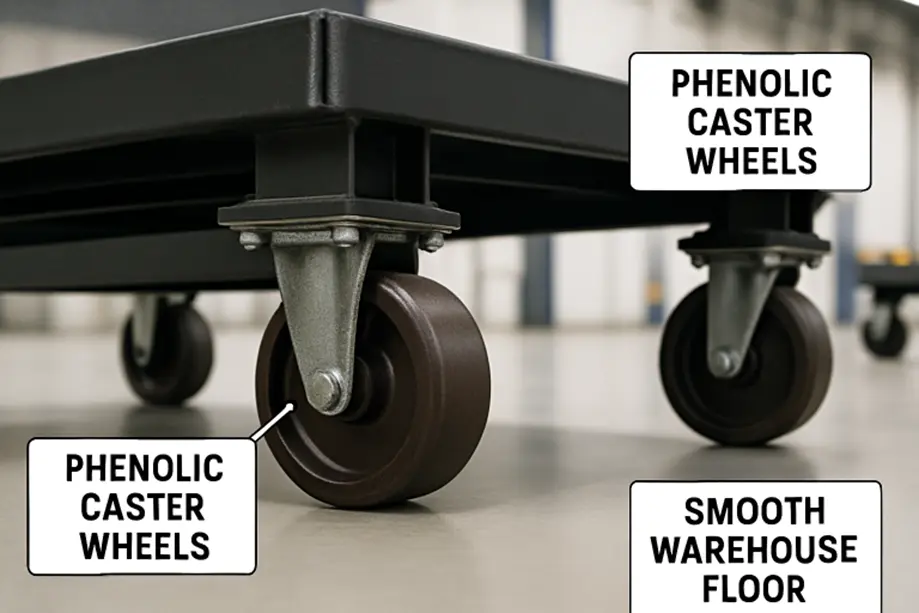
When deciding how to equip industrial facilities, the choice of caster wheels can significantly impact both efficiency and operational costs. Phenolic caster wheels are widely recognized in industrial environments for their outstanding balance of strength, durability, and affordability. Their reputation has continued to grow thanks to their proven performance in demanding applications that require both load-bearing capacity and longevity.
Factories, warehouses, and various commercial sites often face the challenge of moving heavy machinery or loads easily and safely. With the right caster wheels, productivity can be boosted while maintaining excellent worker safety standards. From high load capacity to chemical resistance, understanding the advantages of choosing phenolic wheels can help decision-makers choose the most effective solutions for their workspace.
As industrial facilities update or expand their operations, selecting equipment components, such as caster wheels, is crucial for smooth, efficient workflows. This guide explores why many professionals confidently rely on phenolic wheels for daily use.
Compared to alternatives, phenolic caster wheels deliver a winning combination of performance advantages that can make a meaningful difference in everything from warehouse logistics to institutional facilities.
High Load Capacity and Durability
Phenolic caster wheels stand out for their high load capacity. Their construction, combining phenolic resin with reinforcing fibers, gives them a unique strength compared to traditional wheels. Industrial environments routinely demand equipment mobility for loads that range from a few hundred pounds to several tons. With phenolic wheels, even heavy-duty carts and machinery can be moved swiftly and with minimal physical effort.
Durability is a significant factor in their popularity. Their hard and dense structure helps reduce wear over time, making them ideal for settings that require frequent repositioning of equipment. The wheels maintain their structural integrity despite repeated impacts or heavy use, reducing maintenance and replacement costs in the long run.
Chemical and Temperature Resistance
Industrial environments often expose wheels to substances like oils, greases, and solvents. Phenolic caster wheels are highly resistant to these chemicals, making them particularly useful in settings where spills and routine exposure are likely. Their chemical resistance minimizes wheel degradation and maintains performance over time, thereby reducing downtime and improving reliability.
Temperature is another critical variable in industrial operations, from freezers to baking facilities. Phenolic wheels can typically operate over a broad temperature range, from as low as -50°F to 250°F, and some models withstand temperatures up to 300°F. This adaptability is essential in food processing, foundries, and automotive manufacturing, where consistent performance at extreme temperatures is required. For additional information on suitable materials for different workplace environments, you can visit Blickle’s wheel and caster guide.
Cost-Effectiveness
One of the strongest arguments for selecting phenolic wheels lies in their affordability relative to their performance. Whereas metal or premium polymer caster wheels may provide excellent durability or specialized features, they often come with a much higher upfront cost. Phenolic caster wheels deliver a robust, long-lasting solution at a price point accessible to many businesses, allowing organizations to equip large fleets or facilities while keeping budget constraints in mind.
Despite the lower price, manufacturers do not compromise on essential performance. Facility managers often choose phenolic caster wheels when they need a cost-effective upgrade or replacement that ensures reliability without the long-term costs of frequent repairs or replacements.
Ideal Applications
Phenolic caster wheels are especially well-suited for clean, smooth surfaces, such as those found in warehouses, distribution centers, and manufacturing plants. Their rugged tread rolls effortlessly on polished concrete or tile, making them ideal for tasks that require minimal push force and consistent movement.
- Warehouses
- Distribution centers
- Manufacturing floors
- Automotive facilities
- Institutional settings
Their resistance to abrasion makes them preferred in environments where debris and sharp particles may be encountered. On clear, well-maintained floors, phenolic wheels can move heavy equipment with ease, supporting fast-paced, high-volume workflow with fewer interruptions. For a comprehensive look at how caster wheel choice impacts safety and efficiency, MHI provides additional industry-specific insights.
Considerations and Limitations
Despite their many advantages, phenolic wheels present some limitations that should be considered before implementation. Their biggest drawback is sensitivity to moisture. Extended exposure to humid or wet environments can cause deterioration of the phenolic resin, leading to swelling, cracking, or delamination. This makes them unsuitable for outdoor use or applications where floors are routinely washed down or exposed to weather.
Another potential concern is noise. The hardness that gives phenolic wheels their durability and low rolling resistance can also make them quite loud on hard surfaces, especially when moving heavy loads. In noise-sensitive environments, such as hospitals or schools, alternatives like rubber or polyurethane wheels may be a better choice.
The hardness of phenolic caster wheels contributes to accelerated floor wear, particularly on surfaces that are not perfectly smooth. Regular cleaning and maintenance of both the wheels and the facility floor can mitigate this problem and ensure optimal wheel life and performance. Facilities managers should also be aware that using phenolic wheels on rough or uneven surfaces can lead to more frequent replacements.
Conclusion
Phenolic caster wheels are an optimal choice for industrial applications that prioritize high load capacity, cost-effectiveness, and durability under dry conditions. Their resistance to chemicals and heat, alongside their affordability, makes them a reliable and trusted component for warehouses, factories, and distribution centers. However, their use should be carefully assessed in environments where moisture or noise is a concern. As with any equipment investment, ensuring a match between caster wheel properties and specific workplace requirements will deliver the best long-term performance and value.
Also Read-Unstoppable Moves: Fresh Techniques for Peak Basketball Performance

